New Publication Explores Global Gaps in Marine Ecosystem Services Research
A new paper co-authored by B-USEFUL partners has just been published in the journal Ecosystem Services, offering one of the most comprehensive syntheses to date of how marine and coastal habitats support ecosystem services worldwide.
The study, titled “A global synthesis of ecosystem services records and their associations with marine and coastal habitats”, analysed 3316 records across 139 countries using the Common International Classification of Ecosystem Services (CICES) framework. The authors explored how different marine habitats contribute to provisioning, regulating, and cultural ecosystem services, while also identifying major geographic and thematic knowledge gaps.
Key Findings
- Mangroves, seagrasses, and coral reefs dominate the literature
These habitats were associated with nearly all ecosystem service classes and remain among the best studied ecosystems for policy and valuation purposes. - Major marine habitats remain underrepresented
Pelagic systems, kelp forests, continental shelves, intertidal mudflats, sea ice, and deep-sea habitats were linked to far fewer ecosystem services and have received considerably less scientific attention. - Strong geographic biases persist
Africa, South America, and Oceania remain significantly underrepresented in ecosystem services research, despite hosting globally important marine ecosystems. - Important service gaps remain poorly studied
Biological control, sediment regulation, and energy provision were identified as major research gaps, while ecosystem disservices remain largely absent from the scientific literature.
The authors highlight that although marine ecosystem services research has grown rapidly since 2008, the field is still strongly shaped by accessibility and funding patterns rather than ecological importance or policy urgency. Addressing these gaps will be essential for evidence-based marine conservation, restoration, and management.
The figure below illustrates the associations identified between different ecosystem services and marine/coastal habitats. Ribbon width represents the number of published records linking habitats to specific ecosystem service categories.
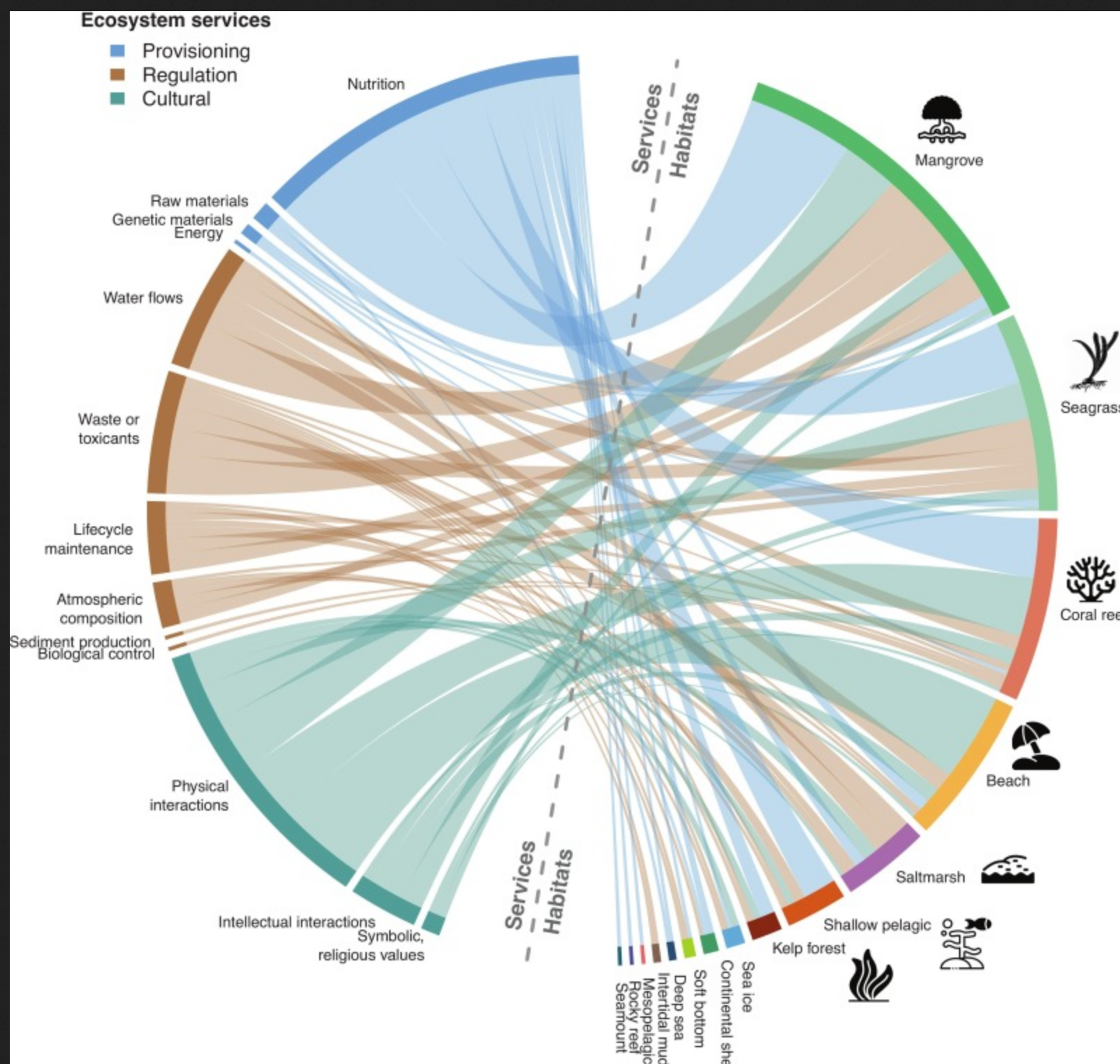
Associations between ecosystem services and marine/coastal habitats identified through the literature review.